To read my latest work, please subscribe to my newsletter. Here are a few pieces I’ve published over the years:

From Solitaire to Solidarity | COLUMBIA JOURNAL
The day after Edward Abbey died, in the spring of 1989, his friends and family wrapped his body in a sleeping bag, packed it in dry ice, and loaded it into the bed of a blue Chevy pickup. They drove west out of Tucson, then south toward Mexico, cruising along the blacktop, then crunching dirt and rock as they chased the late-afternoon sun deep into the heart of the Sonoran Desert. There, amid the flat, alluvial basins and the ragged, looming ranges of the Cabeza Prieta Wildlife Refuge, somewhere just north of the borderline, in the brittlebush and creosote and ocotillo and saguaro stands, they committed Abbey’s body to the earth. They chiseled his epitaph into a slab of varnished basalt: “EDWARD PAUL ABBEY / 1927-1989 / ‘NO COMMENT.’” …
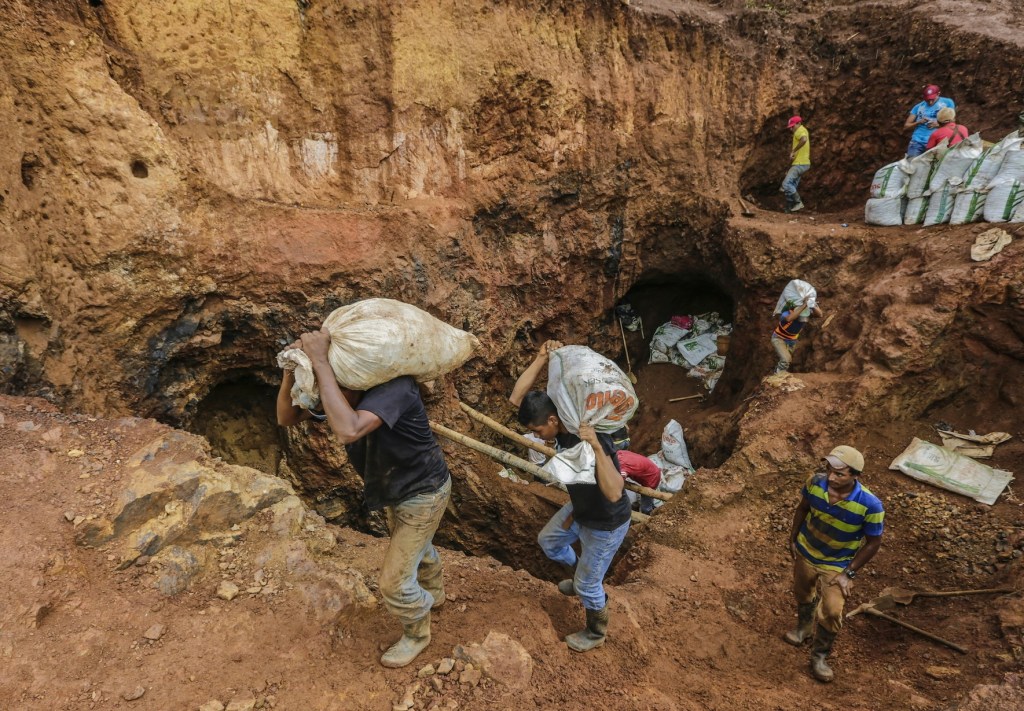
Nicaragua’s Gold Rush: A New Frontier of Corporate Extraction | EL FARO
A modern-day gold rush is poisoning ecosystems and terrorizing Indigenous and Afro-descendant communities in Nicaragua, as corporations and settlers invade autonomous territories and nature reserves, stealing land and extracting profits in a lucrative business environment enforced through state and paramilitary violence. Community members who oppose mining and displacement have been threatened, attacked, sexually assaulted, disappeared, imprisoned, exiled, tortured, and killed. Meanwhile, the gangs of settlers responsible—often former soldiers with ties to the ruling regime of Daniel Ortega and Rosario Murillo—are rarely, if ever, held accountable.

As Europe Welcomes Ukrainian Refugees, It Leaves Other Migrants Caught “Between two deaths” | THE INTERCEPT
The EU’s commendable displays of sympathy and hospitality toward Ukraine’s mostly white, mostly Christian refugees stand in violent contrast to its policies of deterrence, detention, and state-sanctioned death targeting African and Middle Eastern asylum-seekers by the millions. “We are wondering,” Ahmad al-Hariri, who fled the war in Syria 10 years ago and has been trying to reach Europe ever since, told Reuters, “why were Ukrainians welcome in all countries while we, Syrian refugees, are still in tents and remain under the snow, facing death?” The contrast, to put it crudely, is as clear as black and white …
The Trials of Scott Warren | THE BAFFLER
Scott Warren is just one of thousands of residents and humanitarian volunteers responding to the needs of migrants and refugees in the O’odham lands of the Sonoran desert. By targeting him and other borderland aid workers, the United States has demonstrated the lengths it will go to destroy the lives of migrants and forestall the radical possibilities prefigured in acts of care and solidarity. The Trump administration has sought to intimidate residents and establish a legal precedent that would criminalize humanitarian care—a precedent that would classify hospitality as harboring, search and rescue as smuggling, and aid as aiding and abetting. …

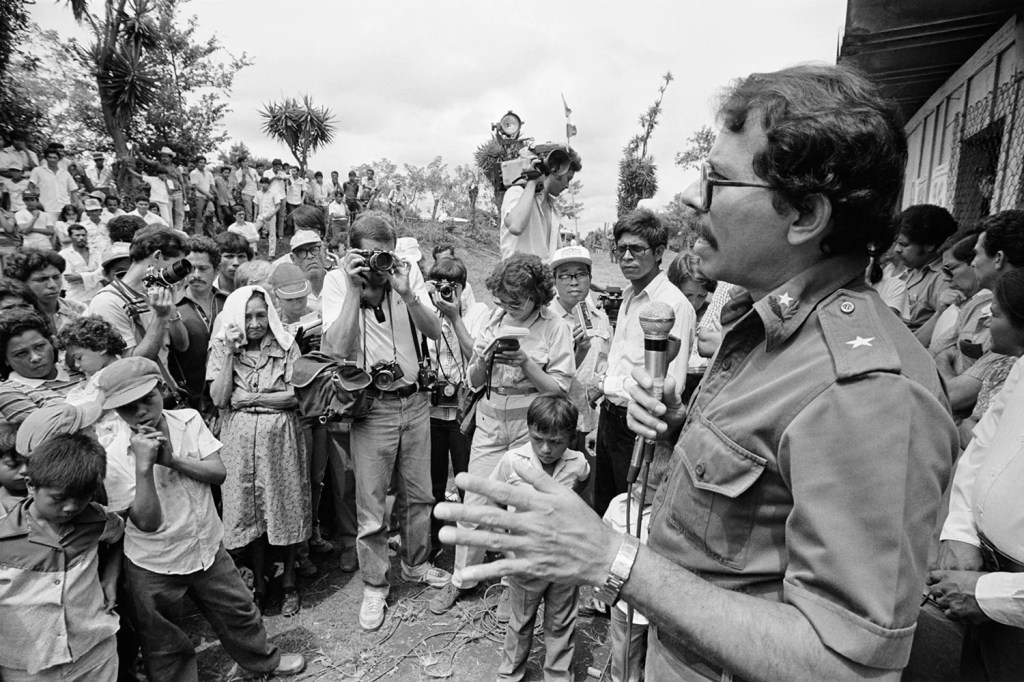
Is Nicaragua’s Ortega-Murillo Dictatorship Nearing Its End? | FOREIGN POLICY
This summer marks the 45th anniversary of the Nicaraguan Revolution, when the guerilla forces of the Sandinista National Liberation Front (FSLN) overthrew the Somoza dictatorship, the U.S.-backed dynasty that had ruled the country for more than 40 years. On July 19, 1979, after nearly two decades of struggle, armed Sandinistas entered the capital of Managua victorious, their red and black bandanas heralding a new era of socialist transformation. […] Today, 17 years into Ortega’s rule, the 1979 revolution’s promise of liberation and equality has become little more than window dressing for another iron-fisted dictatorship.
You Shall Also Love the Stranger | GUERNICA
Upon hearing that his friend Walter Benjamin had committed suicide rather than face deportation into the hands of the Nazis, Bertolt Brecht composed a short elegiac poem, “On the Suicide of the Refugee W.B.” “Empires collapse,” he wrote. “Gang leaders / are strutting about like statesmen. The nations of man / No longer visible under all those armaments.” […] Today, another fascism is rising from the ashes of a past that never fully died: a new stage of neoliberal power, presaged by the tragedy of Pinochet and consummated in the deranged and farcical specter of Trump or Bolsonaro—an era of capitalist violence and dispossession perhaps even more savage than the last. …
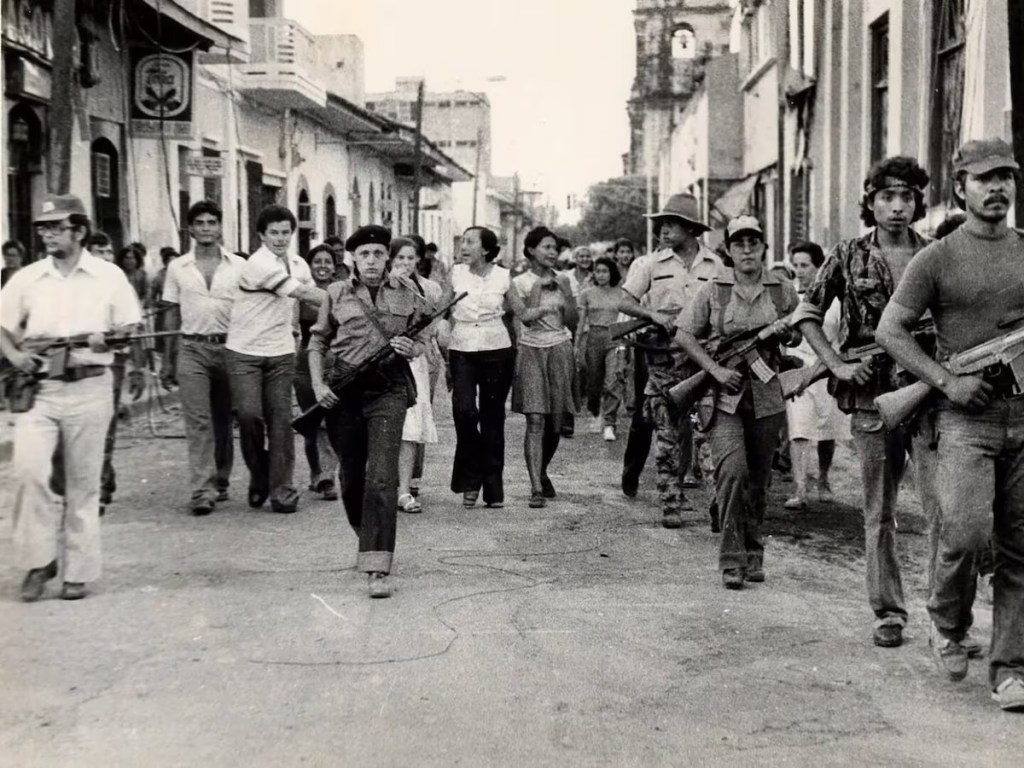
Dora María Téllez: ‘We must act for Nicaragua once more’ | EL PAÍS [también en español]
In 1973, at 20 years old, Dora María Téllez quit medical school to join the armed struggle against the Anastasio Somoza dictatorship. Three years later, she was enrolled in guerilla combat and medic training in Cuba. Riding the wave of revolution in the late 1970s, Téllez rose to the top of the guerilla command structure, leading FSLN cadres into battles across the country. By 1978, she was known as “Comandante Dos” of the insurrectionist Terceristas and was one of three Sandinista commanders to lead the pivotal assault on Nicaragua’s National Palace. […] “The plan seemed too simple to be sane,” Gabriel García Márquez wrote in a chronicle recounting the assault. So simple and insane, in fact, that it worked. …
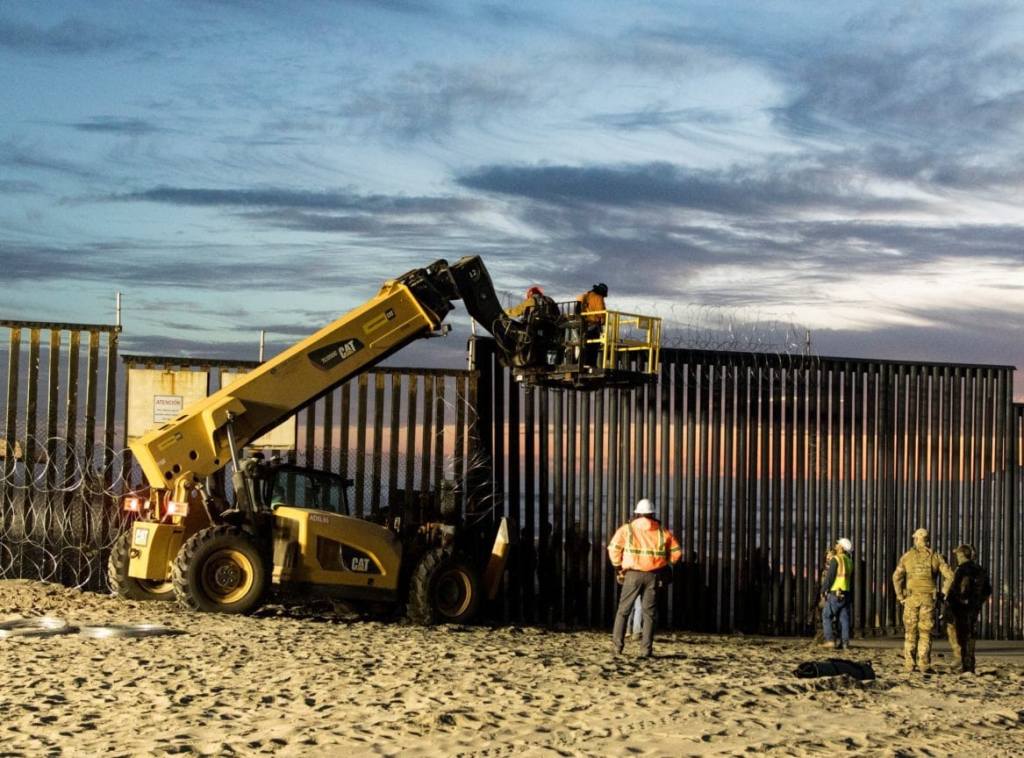
The Border Patrol Is Leaving Migrants to Die | HIGH COUNTRY NEWS
In southern Arizona’s vast deserts, distances are often deceiving. A person can walk for days and not see any sign of civilization, save for the web of foot trails worn deep into the dirt, haunted by the debris of those who crossed before: rusted tuna cans, sun-weathered backpacks, empty water bottles, human skeletons. Over decades, the U.S. government has disfigured this spectacular terrain with the technology of war, using walls and highway checkpoints to funnel migrants deeper into the wilderness, far from help. Thousands attempt the dangerous and difficult crossing each year. …

Biden’s Immigration Bill Will Do Little to End Death and Suffering in the Borderlands | EL FARO
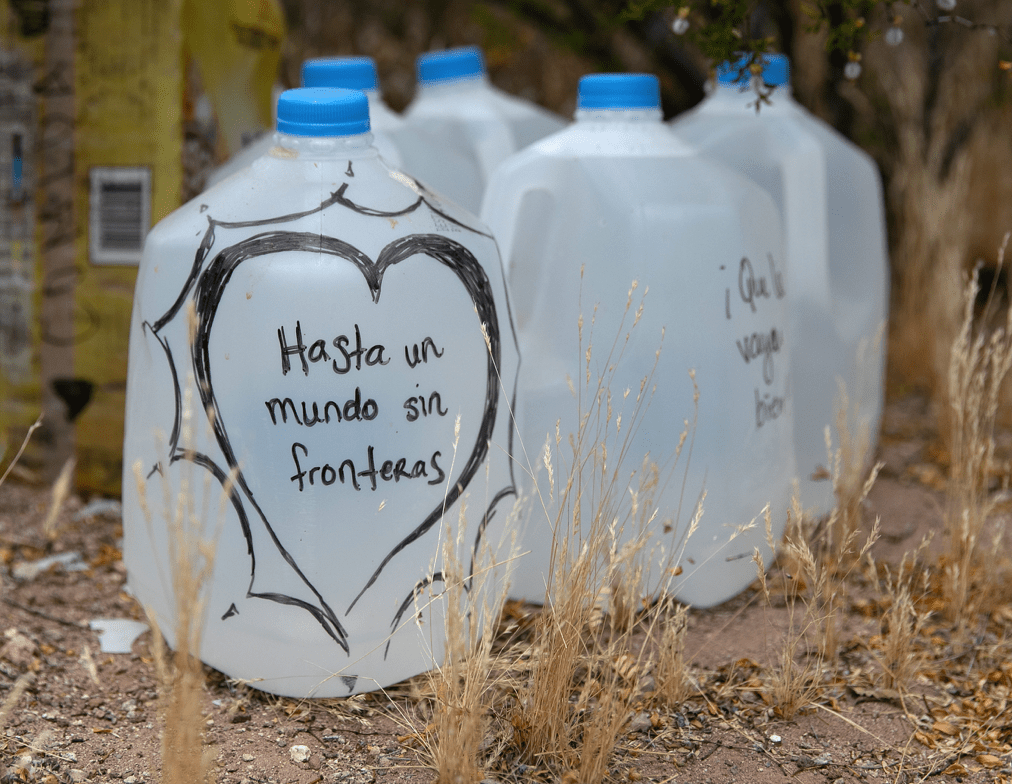
Sadly, but not surprisingly, Biden’s new immigration bill — the U.S. Citizenship Act of 2021 — as well as his executive actions thus far, do nothing to significantly and directly address the massive loss of life in the U.S. borderlands, and offer little in the way of indirect solutions. In lock-step with the tried and tired political tradition of “comprehensive immigration reform” — the idea of marrying together stricter border and immigration enforcement with slow, winding paths to legalization — Biden’s bill is actually aimed at precisely the opposite: escalating death-as-deterrence border enforcement under the guise of “smart border controls” and the spurious “humanitarian” initiatives of Border Patrol. …
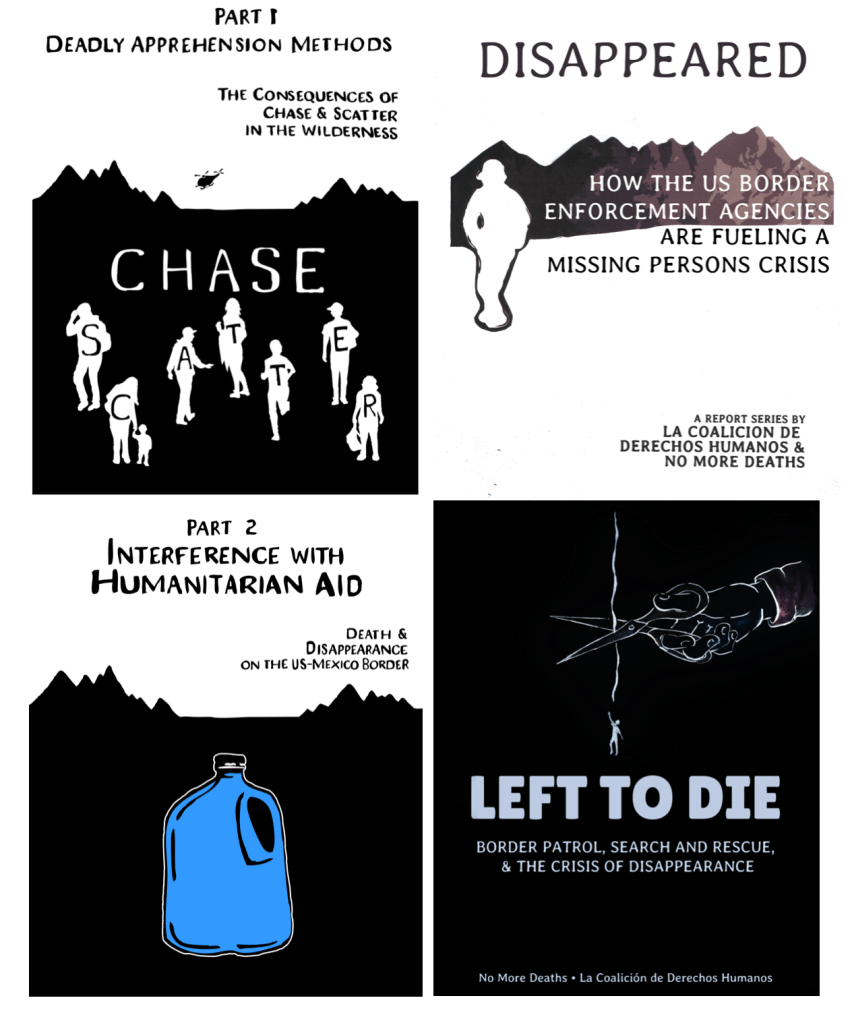
Disappeared: How U.S. Border Enforcement Agencies are Fueling a Missing Persons Crisis (Coauthor) | NO MORE DEATHS
There is a search and rescue crisis in the borderlands. Every year, hundreds of thousands of people seek to enter the United States by way of the southern border. Some are fleeing U.S. sanctioned violence, severe poverty as a result of U.S. foreign policy and intervention, or the disastrous and escalating effects of global climate change. Others are seeking to rejoin their families and communities after being deported from the places they call home. As a diversity of geopolitical forces compel people to leave their countries of origin, increasingly insurmountable restrictions to legal entry mean that for many, the only option is to enter the United States without authorization, crossing rivers or trekking miles through deserts. For years, US Border Patrol policy has deliberately pushed people crossing the border without official permission into remote and dangerous areas. Border Patrol’s “Prevention Through Deterrence” strategy has concentrated enforcement in relatively safe urban areas, with the stated intention of diverting migration into what the agency itself describes as “more hostile terrain.” …
 Max Granger